Using Technology to Anticipate Complications from Gestational Diabetes
Continuous glucose monitoring generates a volume of data that is difficult to analyze manually. Through data science, a preliminary study transforms this information into personalized clinical metrics and lays the groundwork for future predictive models of perinatal risk in Chile.
Gestational diabetes (GD) affects approximately 10% of pregnancies worldwide, and in Chile its incidence has risen steadily over the past two decades, reaching 56.5 cases per 1,000 births in 2022.
In response to this situation, researchers at the Millennium Institute iHEALTH are working on the FONDEF ID2510588 D-EVITA project, an initiative that leverages explainable artificial intelligence to anticipate, in a personalized way, perinatal complications in pregnant women with gestational diabetes mellitus.
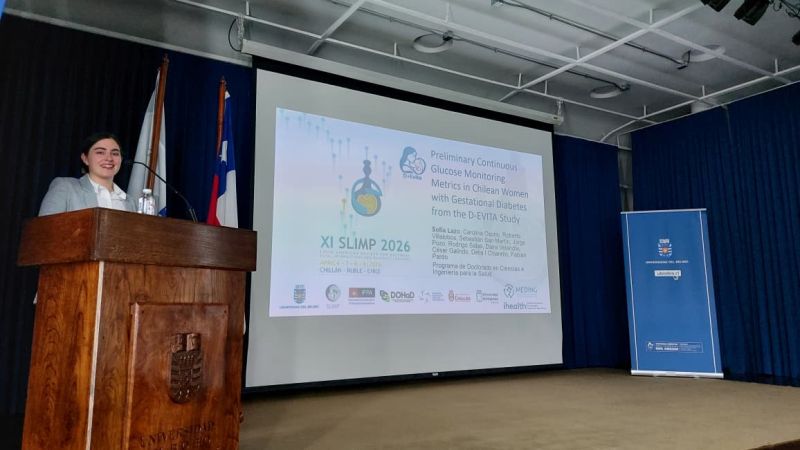
As part of this project, researcher Sofía Lazo, a doctoral student in Health Sciences and Engineering at the Universidad de Valparaíso, recently presented preliminary results at the XI International Congress of the Latin American Society for Maternal-Fetal Interaction and Placenta (SLIMP) 2026, held in Chillán, Chile.
The work, titled "Preliminary Continuous Glucose Monitoring Metrics in Chilean Women with Gestational Diabetes from the D-EVITA Study," draws from continuous glucose monitoring (CGM) applied to 14 Chilean women with gestational diabetes over a period of 1 to 14 days, with measurements taken every 15 minutes.
Unlike traditional monitoring — which provides a snapshot of blood sugar levels through fingerstick tests at specific times of day — CGM uses a small sensor placed on the skin that records glucose levels in the tissue throughout the day and night. This makes it possible to detect variations that conventional methods might miss: sharp spikes after meals, drops during sleep, or other patterns that are key to the timely management of the condition.
"Each patient generates a large amount of data, and analyzing this information manually is very time-consuming. What did we do? Using data science, we modeled the biological signal to generate advanced metrics that allow for clinical analysis of a patient, such as average blood glucose, standard deviation, and time in ideal range, among others," said Sofía.
The study concludes that CGM enables a detailed characterization of glycemic dynamics in pregnant women with GD, providing clinically relevant information "far beyond what conventional monitoring can offer," as the iHEALTH researcher emphasizes. Furthermore, the results open the door to future predictive models of perinatal risk in the Chilean population.
The tool also has direct educational value: by continuously recording each patient's patterns — eating schedules, variations between weekdays and weekends, episodes of hypo- or hyperglycemia — the clinical team can intervene in a more targeted and personalized way, even in settings where consultation time is limited.
This is not the first time Sofía Lazo has stood out at international events in this field. In September 2025, she presented the work "Risk Factors for Gestational Diabetes Using Explainable Machine Learning in a Chilean Population" at the 13th World Congress of the International DOHaD Society, held in Buenos Aires. That study used explainable machine learning to predict GD risks from more than 11,000 clinical records from Hospital San Camilo between 2015 and 2021.
About D-EVITA
The D-EVITA project — selected in ANID's IDeA I+D 2025 competition — is led by Dr. Fabián Pardo (Universidad de Valparaíso), adjunct researcher at iHEALTH, and Dr. Indira Chiarello (Universidad San Sebastián), with the participation of Dr. Rodrigo Salas, principal researcher at iHEALTH, and an interdisciplinary team including Sofía Lazo, Matías Fossa, Matías Salinas, Maite Bahamondes, Carolina Osorio, and Dr. Ayleen Bertini. Its goal is to develop and pilot an explainable AI software tool capable of anticipating perinatal complications in a personalized manner, optimizing public health system resources and reducing gaps in care, particularly in regional areas.


