Network Analysis Reveals Supplier Concentration in Public Procurement of Medical Equipment
A team of researchers from iHEALTH and the Universidad de Valparaíso analyzed more than 1,400 public purchase orders to map the structure of Chile's medical equipment market for the first time.
Every year, the Chilean State purchases more than US$10 billion in goods and services through the Mercado Público platform, a figure equivalent to about 3.5% of the country's gross domestic product. Within this enormous flow, the purchase of medical equipment plays a strategic role: it determines which technology reaches hospitals and, with it, the public system's capacity to diagnose and treat the more than three-quarters of the population who rely on FONASA.
But how is this market organized? Which suppliers account for the largest share of purchases, and in which areas? A new study by iHEALTH Principal Investigator Rodrigo Salas, together with José Lorant, Eyleen Spencer and Débora Buendía from the MEDING Center and the School of Biomedical Engineering at the Universidad de Valparaíso, addresses these questions by turning public procurement data into an analytical map of the system.
Drawing on Mercado Público's open data, which is available under Chile's Transparency Law, the team reconstructed the medical equipment purchase orders awarded between January 2022 and April 2025. After cleaning roughly 280,000 initial records, they obtained a curated dataset of 1,420 transactions connecting 204 public health institutions with 249 suppliers.
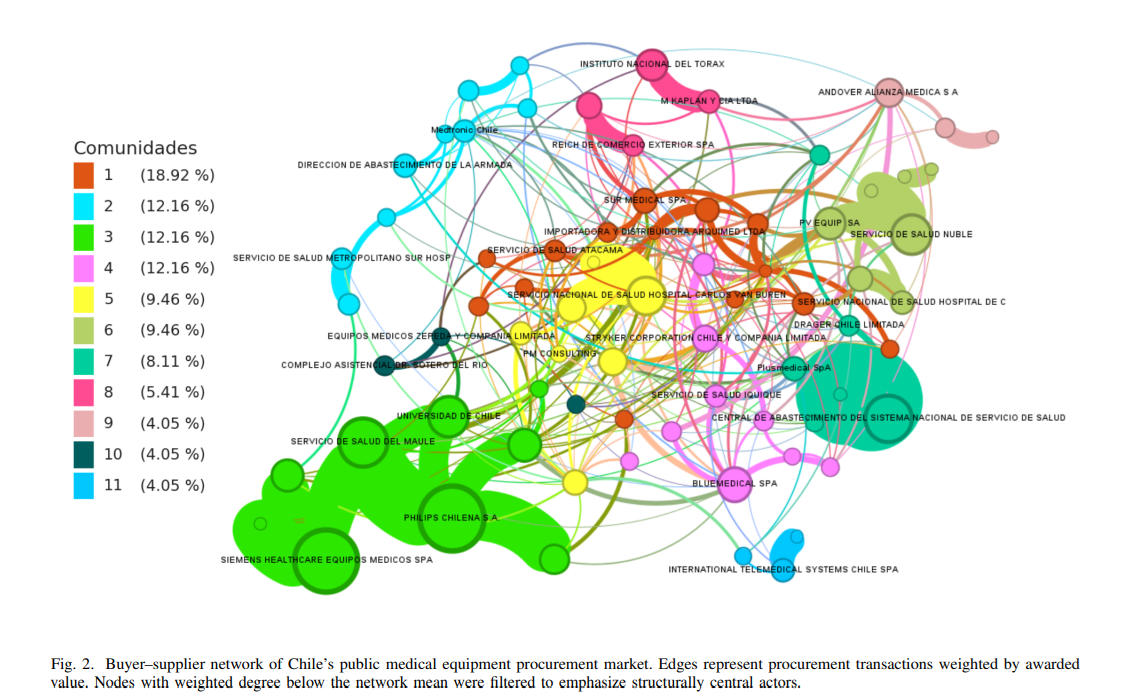
With this information, they built a weighted bipartite network. In this mathematical model, institutions and suppliers are linked through their transactions, and each connection is "weighted" by the amount awarded. When community detection algorithms were applied, the system, which at first glance looks like a tangle of thousands of connections, showed a clear structure: 11 well-defined communities, meaning groups of institutions and suppliers that mainly buy from and sell to one another.
The study's central contribution is to formally quantify supplier dependence using the Herfindahl-Hirschman Index (HHI), the same metric competition authorities use to measure market concentration.
The results show that this dependence is not evenly distributed. Communities linked to surgical equipment proved competitive, with several suppliers sharing the market. By contrast, the community dominated by medical imaging, led by Siemens and Philips, reached an HHI of 0.340. This exceeds the high-concentration threshold and signals a real risk of dependence. This is no coincidence: imaging equipment involves high barriers to entry, standardization and long-term maintenance, all of which reduce the number of viable suppliers.
The analysis also brought to light patterns that are hard to detect with conventional statistics. In one community, for example, civilian health services share suppliers with defense-sector bodies, namely the Navy and the Air Force, showing procurement networks that cut across traditional administrative boundaries.
Beyond the diagnosis, the study proposes a replicable methodology for evidence-based procurement planning and for risk monitoring in health technology management. Identifying where dependence is concentrated makes it possible to anticipate vulnerabilities in pricing, continuity of supply or technological dependence before they affect patient care.
The authors plan to extend the approach by analyzing how these communities change over time and by applying it to other countries in the region, to see whether these patterns hold beyond Chile.
Lorant, J., Spencer, E., Buendía D., Salas R. Bipartite Supplier–Healthcare Network Analysis for Detecting Communities and Structural Dependencies in Chile’s Public Procurement of Medical Equipment. 24th LACCEI International Multi-Conference for Engineering, Education, and Technology: “Engineering without Borders: Artificial Intelligence, Knowledge, Innovation, and Alliances for a Future from the Americas”. Hybrid Event, Santiago-Chile, July 15–17, 2026. https://dx.doi.org/10.18687/LACCEI2026.1.1.2745
