Computational Angiography: Physics-based Modeling and Machine Learning for Vascular Disease Diagnosis
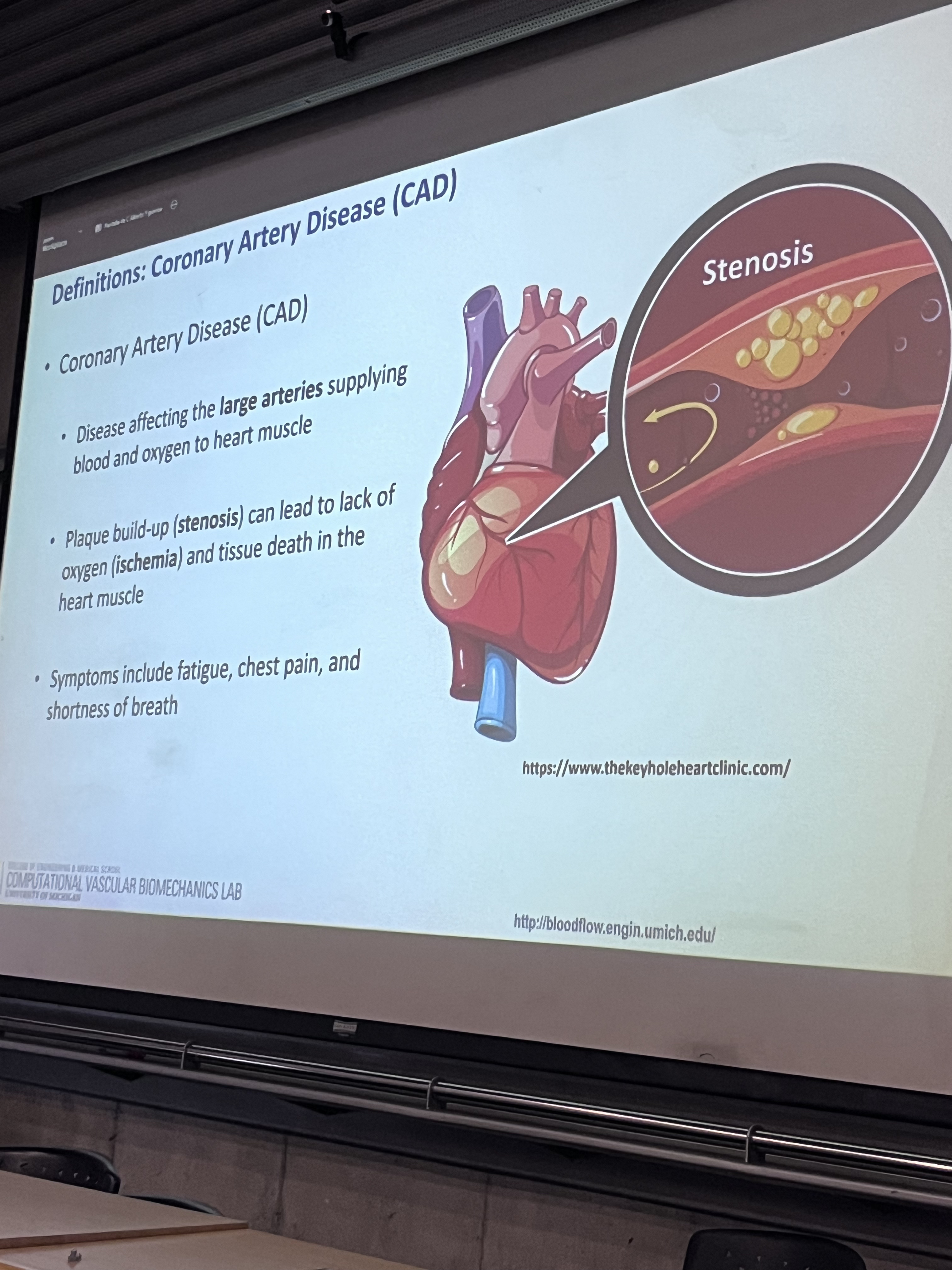
A research project presented at the iHEALTH Seminar Series on Tuesday, April 14, by Professor C. Alberto Figueroa of the University of Michigan, seeks to develop computational methods to address microvascular dysfunction by leveraging the information provided by coronary angiography.
Coronary microvascular dysfunction (CMD) is a heart condition in which the small blood vessels of the heart fail to dilate properly, reducing blood flow and causing ischemia — often without obstructions in the large arteries. It causes chest pain (angina), fatigue, and shortness of breath, and is more common in women.
Several diagnostic procedures exist — both anatomical and functional — for evaluating this condition, ranging from functional stress tests that do not produce vascular images, to positron emission tomography (PET), a non-invasive nuclear imaging test that uses tracers to assess blood flow and cardiac metabolism, and can detect perfusion deficits both at rest and under stress.
"In terms of available devices, they can be classified according to whether they evaluate the system globally, only large vessels, or small vessels." However, as Figueroa noted: "computational methods that specifically address microvascular dysfunction are currently scarce. Our research focuses on developing methods that leverage coronary angiography data for this purpose," he explained in his talk Computational Angiography: Leveraging Physics-based Computational Modeling and Machine Learning for Large and Small Vessel Disease Diagnosis.
Coronary angiography is based on X-ray imaging, is two-dimensional, and uses a contrast agent. When describing the technical characteristics of modern angiography, Figueroa highlighted both its strengths and limitations: "modern systems allow video acquisition stereoscopically with two simultaneous arms. Advantages include higher resolution than CT and real-time capability at 10–15 frames per second. Disadvantages are that it is two-dimensional and the videos are not synchronized."
According to data presented by the specialist, at least 4 million angiographies are performed per year in the United States and Europe alone, and probably 10 million worldwide. Yet this scale contrasts with the limited use that has been made of the information these images contain. "Historically, cardiology has used them only for anatomical purposes, even though they contain a great deal of information about flow physics," Figueroa noted.
For this reason, the researcher's laboratory develops blood flow modeling tools that combine medical imaging, machine learning, and computational fluid and solid mechanics. Using AI, they evaluate the coronary arteries through X-ray angiography.
"Our primary target is the microvascular territory. If you can describe the position of the contrast agent frame by frame, you can create contrast intensity histograms throughout the entire coronary tree. The question is: can these histograms reveal what is happening in the microcirculation?" the researcher asks. The answer is yes.
According to Figueroa, the answer is affirmative, and his team already has computational evidence to support it. To demonstrate this, they developed a model that physically simulates how the contrast agent behaves within the vascular system: "we coupled the Navier-Stokes equations with an advection-diffusion equation to simulate contrast injection, which allows us to calibrate models and create computational angiograms. By varying only microvascular resistance while keeping everything else constant, we get exactly what intuition predicts: higher resistance equals slower washout."
Stokes-PINNs
The second presentation in the Seminar Series, delivered by Jeremías Garay, a postdoctoral researcher at iHEALTH, addressed how to simulate blood flow in complex geometries — those that appear frequently in the cardiovascular system: coronary arteries, intracranial arteries, and also in the aorta.
"When we have all the information available, classical numerical methods work very well. The problem is that we often don't have all the data, and if we use averaged parameters, we lose patient specificity," analyzed the researcher, who currently serves as a professor in the Department of Computer Science at Universidad Técnica Federico Santa María.
This is where physics-informed neural networks (PINNs) offer greater flexibility: "they allow solving problems and inferring missing data at the same time as solving the forward problem," Jeremías added.
"Based on the Stokes modes method, we encode all geometric information beforehand, producing an infinite set of basis solutions, each tailored to the geometry of the domain, for both velocity and pressure. This rich information is fed into the network before training — what we call Stokes-PINNs," the researcher explained.
The results validate the approach: with only a few sensors available, Stokes-PINNs achieves a notably more accurate approximation of the solution than classical PINNs. For Garay, the key lies in not wasting what is already known before training the model: "we make the most of all available information before training."


