Beyond "is AI good or bad?": an article that reframes the ethical debate
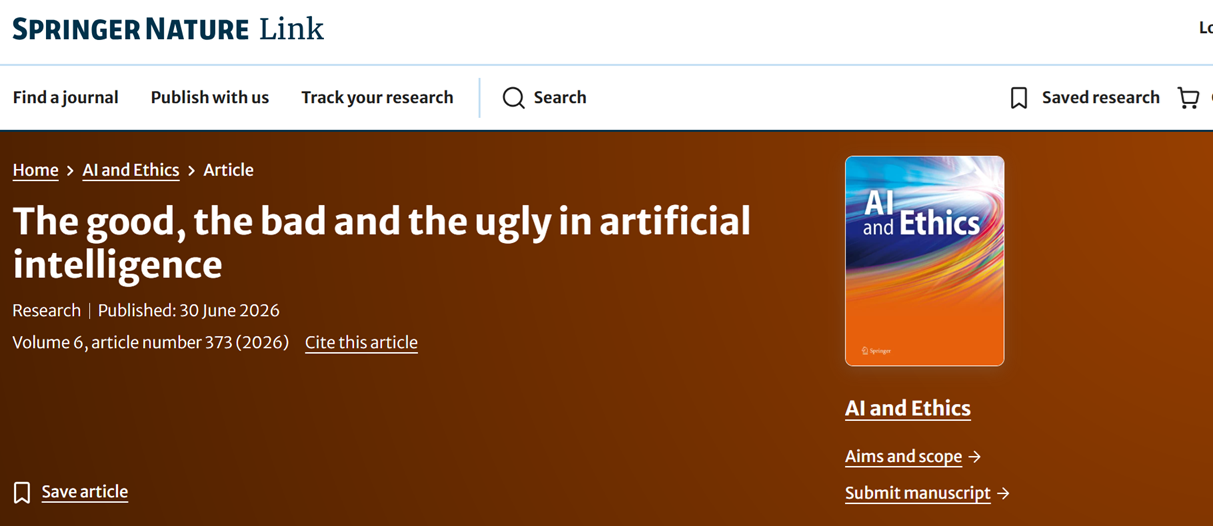
With a nod to Sergio Leone's 1966 classic, a publication in the journal AI and Ethics (Springer Nature) titled "The Good, the Bad and the Ugly in Artificial Intelligence" proposes an ethical framework for identifying who is responsible when AI causes harm: the system, the institution, or the people behind it?
The work by researchers Domingo Mery and Jocelyn Dunstan —academics at Pontificia Universidad Católica de Chile and members of iHEALTH— together with Gabriela Arriagada-Bruneau, from the Institute for Mathematical and Computational Engineering (IMC) and the UC Institute of Applied Ethics, organizes the analysis of AI into three broad categories: the good, referring to its transformative opportunities in health, education, and productivity; the bad, encompassing its persistent technical limitations such as bias, lack of explainability, and privacy risks; and the ugly, pointing to deliberate misuse and ethical violations arising from human decisions in the development and deployment of these systems.
Beyond cataloguing applications and harms, the article introduces two original theoretical contributions. The first is the Indistinguishability thesis, which holds that, in many real-world situations, a technical AI failure (the bad) and an ethically blameworthy harm (the ugly) are phenomenologically identical to those who suffer them.
The second is the Ethical Responsibility Gradient (ERG), an analytical tool that maps AI harms along two axes—actor agency and epistemic state—and defines four governance zones: systemic-structural, organizational negligence, market-incentive distortion, and malicious intent.
"The good, the bad and the ugly are not fixed properties of AI systems. They are outcomes produced by the interaction of technical capabilities with human decisions, institutional structures, and social contexts," the authors note.
These contributions aim to move beyond the binary approaches that dominate the public debate on AI and to offer concrete tools for more adaptive, contextual, and fair governance.
As the article concludes, the responsible use of AI is a shared duty that cannot wait for specific regulations to emerge: it falls on individuals and institutions alike, across every domain in which this technology operates.
Mery, D., Arriagada-Bruneau, G. & Dunstan, J. The good, the bad and the ugly in artificial intelligence. AI Ethics 6, 373 (2026). https://doi.org/10.1007/s43681-026-01200-5
