Artificial intelligence makes it possible to anticipate acute kidney injury in ICU patients using data from the first 24 hours
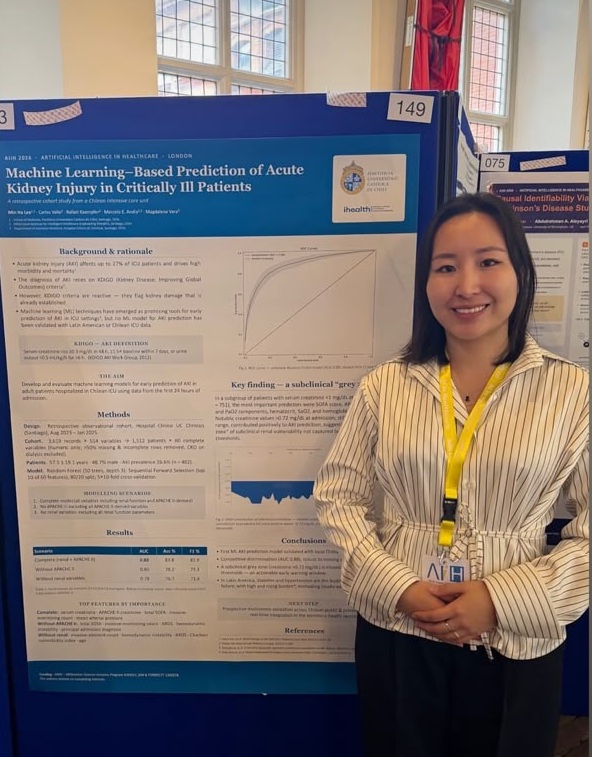
The study, based on records from 1,512 patients at Hospital Clínico UC Christus, was presented by Min Ha Lee, a PhD student in Medical Sciences at UC and member of iHEALTH, at the AIiH 2026 conference in London.
Roughly one in four patients admitted to an Intensive Care Unit (ICU) develops acute kidney injury, a complication that raises the risk of long-term sequelae and death. The problem is that it is currently detected late: the diagnostic criteria used worldwide, known as KDIGO, rely on signs that only appear once the kidney is already damaged.
Getting ahead of that damage is the goal of the work that Min Ha Lee, a PhD student in Medical Sciences at Pontificia Universidad Católica de Chile and an iHEALTH researcher, presented at the Third International Conference on AI in Healthcare (AIiH 2026), held August 26–28 at Imperial College London.
“The diagnostic criterion we use today is reactive, meaning it detects the damage after it has already happened. We wanted to know whether, using data from the first 24 hours of hospitalization, we could predict acute kidney injury. And the answer is yes, we can,” the researcher explains.
A model trained on local data
The team worked with anonymized clinical records from 1,512 adult patients hospitalized in the ICU at Hospital Clínico UC Christus between August 2023 and January 2025. With this information, they trained a Random Forest machine learning model, which combines many “decision trees” to estimate which patients are at higher risk.
The full model was correct in about 84% of cases and reached a score of 0.88 on the standard measure of predictive ability (AUC-ROC), on a scale where 0.5 is equivalent to chance. Performance remained clinically relevant even when APACHE variables were removed.
The study also produced a striking finding. In patients admitted with apparently normal kidney function, creatinine values still within the normal range but above 0.72 mg/dL were already associated with higher risk. This suggests a “gray zone” of vulnerability that current criteria fail to capture.
“To the best of our knowledge, this is the first model of its kind developed with data from a Chilean ICU,” Lee highlights. Most of these tools have been created in the United States and Europe, with patients and clinical practices that differ from those in Latin America. The next step, the authors note, is to validate the model in other ICUs across the country, both public and private.
The challenge of free-text data
The work brought to light a common limitation in clinical research. “Much of the valuable information is written as free text, in documents such as discharge summaries, rather than in structured fields. In fact, in this very project we had more variables, but in the end we excluded those that weren’t numerical and complete,” she says.
This gave rise to a second line of work, under development with the ICU team at Hospital Sótero del Río and the iHEALTH engineering team made up of Rafael Kaempfer and Fabián Ortega: using language models that run locally, within the institution itself and with anonymized patient data, to extract structured data from these texts. “This way we can maximize the amount of data available for studies like this one while ensuring that patient confidentiality is protected. The goal is to turn free text into usable data for research, for clinical decision-support tools and, in the future, for improving predictive models such as the one for acute kidney injury,” she explains.
Clinicians and engineers on the same team
Lee began working with Dr. Marcelo Andia, Alternate Director of iHEALTH, when she started her PhD, driven by an interest in AI research. In this study, her contribution focused on providing clinical knowledge and interpreting the results from her medical background. The work was accepted at AIiH 2026 as a poster with a short oral presentation.
“It was a new experience, because I had never been to an international conference. It was very enriching to interact with researchers from other countries and to see the different ways machine learning can be applied in healthcare,” she says.
On the institute’s role, she adds: “iHEALTH has been key, because it brings clinicians and engineers together on the same team, which would be much harder to achieve on your own. The future of healthcare lies in multidisciplinary communication and collaboration, and iHEALTH provides the environment for that to happen.”
